
Data Value Chains:

from Definition to Realization

Context

In February 2020, the European Commission announced the European Strategy for Data, aiming at creating a single market for data to be shared and exchanged across sectors efficiently and securely within the EU. Behind this endeavour stands the Commission’s goal to get ahead with the European data economy in a way that fits European values of self-determination, privacy, transparency, security, and fair competition. This is especially important as the European data economy continues to grow rapidly – from 301 billion euros (2,4 % of GDP) in 2018 to an estimated 829 billion euros (5,8 % of GDP) by 2025.

The centrepiece of the European Data Strategy is the concept of “data spaces”. A Data Space is defined as a decentralized infrastructure for trustworthy data sharing and exchange in data ecosystems based on commonly agreed principles. To realize Data Spaces, a European ‘soft infrastructure’ is needed, specifying legal, operational and functional agreements as well as technical standards for being widely adopted by users. A data space consists of a set of agreements on legal, technical, functional and operational aspects as specified by the general authorisation framework. Based on this framework, actors providing and/or consuming data, as well as software vendors, can implement their own solutions.

On the other hand, the European Commission has been fostering both “Big Data Innovation Hubs” and “Supporting the emergence of data markets and the data economy”, to ensure that the mentioned ‘soft infrastructure’ and actual ‘hard infrastructure’ are made available. Big Data Innovation Hubs aim to break “data silos” and stimulate sharing, re-using and trading of data assets by launching a second-generation data-driven innovation hub, federating data sources and fostering collaborative initiatives with relevant digital innovation hubs. This shall promote new business opportunities notably for SMEs as part of the Common European Data Space.

This is indeed what the REACH project is doing, refining EDI earlier incubator, by better addressing the challenges of data sharing, governance and reuse across multi-stakeholder actors in data value chains. For that, REACH is going beyond EDI, by not only connecting data corporates with innovators, but also engaging with DIHs and envisioning to develop data value-chains and connect these with innovators to create new value-added services (e.g. services to end-users but also optimising connection/ relations among entities within the same value chains).

Data Value Chains (DVCs): definition

To better understand what a Data Value Chain (DVC) is and is useful for, let’s first comprehend where this term derives from. A Value Chain is a set of interlinked resources and processes that begins with the acquisition of raw materials and extends to the delivery of valuable products. A value chain is a set of activities that a firm operating in a specific industry performs in order to deliver a valuable product (i.e., good and/or service) to the end customer. The notion of VC was developed by Porter in the 1980s.

On the other hand, a Data Value Chain (DVC) is a mechanism that defines a set of repeatable processes to extract data’s value step by step throughout its entire lifecycle from raw data to veritable insights. DVC consists of four main steps:

  • Data generation: Capture and record data;
  • Data collection: Collect, validate and store data;
  • Data analysis: Process and analyze data to generate new potential insights;
  • Data exchange: Expose the data outputs to use, whether internally or externally with partners.

Big Data is a logical consequence of the importance that digital technology and services have taken in our lives where the data is multiplying at an unprecedented rate. Hence, Big Data Value Chain (BDVC), a derivative of Data Value Chains (DVCs) which allows to extract hidden reliable insights while relying on the strengths of Big Data to process huge volumes of high velocity, ample variety and (sometimes dubious) veracity data. It generally consists of up to five distinct phases:

  • Data acquisition: Data acquisition refers to the process of obtaining raw data;
  • Data pre-processing: Data pre-processing involves a validation process, cleaning, reduction and data integration to prepare storage;
  • Data storage: Data storage includes not only storage but also the management of large-scale datasets;
  • Data analysis: Data analysis uses analytical methods or tools to model, inspect and mine data to extract value;
  • Data visualization: Data visualization is a method of assisting data analysis. It is a meaningful representation of complex data to show hidden patterns.

In REACH, we use the term DVC for simplicity although we are essentially referring to BDVC, since the main aim of the project is to address industrial challenges by promoting sustainable digital solutions applying Big Data and data analytics. Consequently, within REACH, a Data Value Chains (DVCs) can be defined as a multi-stakeholder data-driven business model where data is securely exchanged among parties, either persons or organisations, with the aim of creating value for all involved stakeholders. The data lifecycle occurs thus throughout different parties. Data is generated (recording and capturing data), collected (validating and storing it), analysed (processing and analysing the data to generate new insights and knowledge) and exploited (putting the outputs to use, whether internally or by trading them) by different partners. Hence, multi stakeholder heterogenous data needs are correlated to generate insights.

REACH comes along with Edward Curry’s statement that “a well-functioning working data ecosystem must bring together the key stakeholders with a clear benefit for all.” For REACH, DVCs bring together data providers, data end users (potentially the data providers who exploit the solutions driven from their data), solution providers and digital innovation hubs who help in the incubation process triggered by a challenge which is addressed through a data-driven, often multi-stakeholder, data solution.
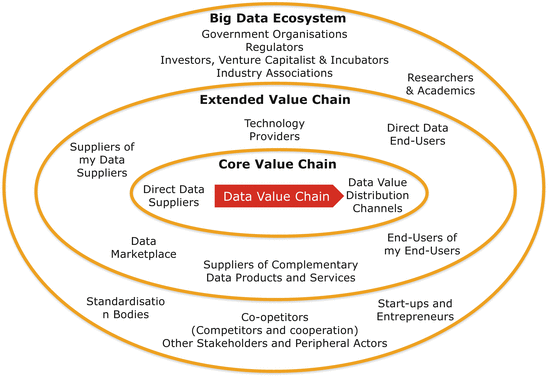
Data Value Chains (DVCs): realization

Providing support for innovation experiments promoting the development of trusted and secure privacy-aware analytics solutions allowing for the secure sharing of proprietary industrial data along with personal data is impending. Besides, such support must ensure compliance with relevant legislation (such as data protection legislation). This is indeed what the REACH project aims to do through its REACH Toolbox, which provides an enabling set of digital trust enabling services that facilitate new developments of Data Value Chains.

However, these tools do not cover the whole lifecycle of multi-stakeholder data analytics, as outlined above, and we deem that these tools should be combined with and complemented by the emerging Open Source building blocks of European Data Spaces. Indeed, the design and implementation of a data space comprises a number of building blocks, which fall under two types: the technical building blocks and the governance building blocks.
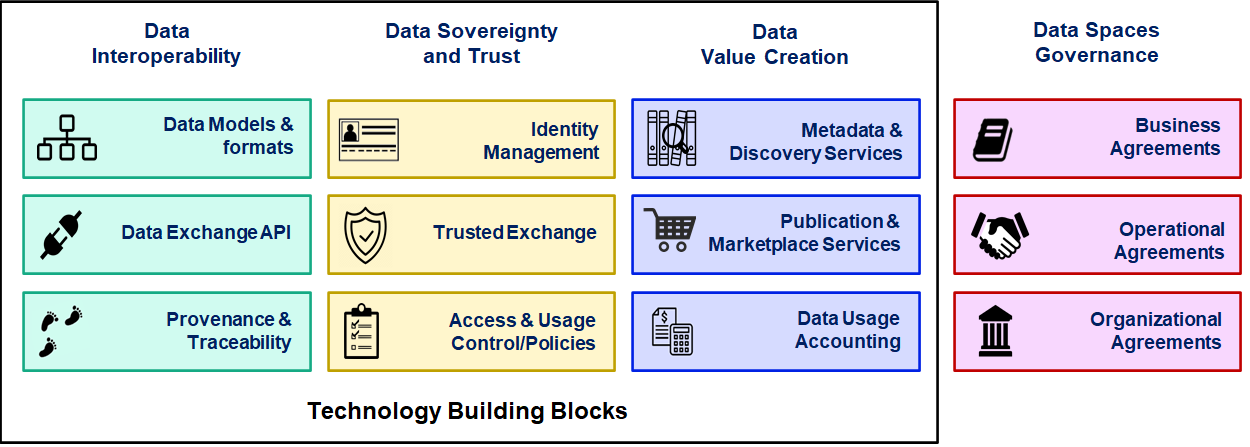
From a technical perspective, a data space can be understood as a collection of technical components facilitating a dynamic, secure and seamless flow of data/information between parties and domains. These components can be implemented in many different ways and deployed on different runtime frameworks (e.g., Kubernetes).

Governance building blocks are artefacts that regulate the business relationships between the groups of stakeholders that can be identified in data-driven business ecosystems: Data owners, Data provider, Data processor and data marketplace operator.

The first phase for establishing data spaces is about converging current European initiatives (e.g. IDSA, Data Sharing Coalition, MyData, BDVA, IHAN, FIWARE or Gaia-X) in order to co-create a single result, which will be well accepted for adoption by a critical mass of stakeholders. This is essentially the mission of the newly formed Data Spaces Business Alliance

Nowadays, there are mainly two driving forces who are pushing the generation of the building blocks that assemble a Data Space, namely IDS and FIWARE. Next, a brief summary of their current complementary offer is given. REACH deems that companies taking part in its incubation program should not only consider using the tools provided within REACH Toolbox but should also have a look to the assets brought forward by IDS and FIWARE. 

IDS building blocks for Data Spaces

The International Data Spaces Association (IDSA) is a consortium formed by companies, scientists, lawmakers and all other relevant stakeholders, with the aim of creating a technical standard to boost the data economy worldwide. IDSA has defined the International Data Space concept, a space in which data is shared in a trustworthy and secure manner. For that, partners belonging to IDSA have developed different components.

The main component is the IDS Connector. The IDS Connector is the central technical component for secure and trusted data exchange. The connector sends your data directly to the recipient from your device or database in a trusted, certified data space, so the original data provider always maintains control over the data and sets the conditions for its use. The connector uses technology that puts your data inside a sort of virtual “container,” which ensures that it is used only as agreed upon per the terms set by the parties involved.

IDS connectors can publish the description of their data endpoints at an IDS meta-data broker. The IDS meta-data broker is a catalogue in which, using an standardized vocabulary, a data provider can promote its data, including the access restrictions, pricing and so on applied to the data. This allows potential data consumers to look up available data sources and data in terms of content, structure quality, actuality and other attributes .

As mentioned before, data sources can be described using different vocabularies (ontologies, reference data modes or metadata elements). The vocabulary provider offers and manages different vocabularies belonging to different domains, to annotate data sources.

The IDS Connector allows establishing a set of rules and restrictions, i.e., a set of governance rules, to decide who is able to access the data source, when, under what conditions, and so on. The IDS clearing house component provides decentralized and auditable traceability of all transactions if needed. In addition, this intermediary provides clearing and settlement services for all financial and data-exchange transactions within the IDS.

In order to build a Data Value Chain and increase the value of the data sources, IDS provides the App store component. App stores provide data apps (DVCs in REACH jargon) which could be deployed in IDS connectors to execute tasks like transformation, aggregation or analytics on the data.

Last, Identity Providers offer a range of services to create, maintain, manage and validate identity information of and for IDS participants and components.

Those components aim to cover the core aspects of the data management described by the European Data Spaces initiative. The IDS Connector is directly related to data governance and data sovereignty, as it allows an organization to share its data sources without losing its control, i.e., knowing who, when and how is accessing its data. In the same way, the IDS clearing house provides decentralized traceability of all data transactions performed. Regarding data brokerage, IDS offers the meta-data broker and the vocabulary provider, the first one enabling a system to publish the metadata about a data source such as the connection details, pricing (if any) and so on, and the second one providing a set of predefined vocabularies to annotate the offered data, fostering the interoperability. Last, the IDS app stores could provide different data-enrichment apps which could be useful in order to perform data analytics and anonymization tasks over the offered data.

FIWARE building blocks (i4Trust) for Data Spaces

FIWARE Foundation is a non-profit organisation that drives the definition and encourages the adoption of open standards to ease the development of portable and interoperable smart solutions in a faster, easier and affordable way, avoiding vendor lock-in scenarios. FIWARE brings a curated framework of open source software platform components which can be assembled together and with other third-party components to build platforms.

The FIWARE software architecture gravitates around management of a Digital Twin data representation: An entity which digitally represents a real-world physical asset (e.g. a bus in a city, a milling machine in a factory) or a concept (e.g., a weather forecast, a product order).

FIWARE provides components to materialize the different technical Building Blocks required for the creation of Data Spaces. Regarding the data interoperability, two elements are critical: a) an API to get access to the data and b) the data models describing the attributes and semantics associated with the different types of Digital Twins being considered. NGSI-v2 API a simple yet powerful RESTful API standardized by ETSI for getting access to context/ Digital Twin data. It is used as the data integration API and is implemented by the core component of the FIWARE architecture: the so-called Context Broker component. It enables to manage context information in a highly decentralized and large-scale manner. NGSI-v2 brings very simple and therefore easy to use operations for creating, updating and consuming context / Digital Twin data but also more powerful operations like sophisticated queries, including geo-queries, or the subscription to get notified on changes of Digital Twin entities.

Also, the FIWARE’s Smart Data Models initiative provides a library of Data Models described in JSON/JSON-LD format which are compatible respectively with the NGSI-v2 APIs or would be useful for defining other RESTful interfaces for accessing Digital Twin data. Data models published under the initiative are compatible with schema.org and comply with other existing de-facto sectoral standards when they exist.

Completing the picture of Building Blocks for Data Interoperability, FIWARE brings components which provide the means for tracing and tracking in the process of data provision and data consumption/use. It provides the basis for a number of important functions, from identification of the provenance of data to audit-proof logging of NGSI-v2 transactions. For those Data Spaces with strong requirements on transparency and certification, FIWARE brings components (i.e., Canis Major) that ease recording of transaction logs into different Distributed Ledgers / Blockchains.

Regarding data value creation building blocks, FIWARE Business Application Ecosystem (BAE) components enable creation of Marketplace services which participants in Data Spaces can rely on for publishing their offerings around data assets they own. FIWARE also comprises components for publication of data resources linked to data assets around which offerings are managed through the FIWARE Data Marketplace. For this purpose, they have the Idra publication platform and an extended version of the CKAN open data platform, which is an open data publication platform widely adopted in the market. These extensions support enhanced data management capabilities and integration with FIWARE technologies. CKAN is not limited to list data resources linked to static files as part of its catalogue but also data resources linked to NGSI-v2 requests served by Context Broker components deployed in a Data Space. This brings the ability to discover data resources relying on DCAT capabilities for publication platforms support.

CONNECT5 – DIH for Connectivity, CPS, IoT, Cloud/Edge and Data Analytics is a national and European DIH supporting the digital and green transformation of SMEs and public organizations. CONNECT5 is a collaborative network, in the form of a Consortium of 12 entities (RTO, polytechnic institutes, universities), with high level of expertise in digital technologies, state-of-the-art infrastructures and a deep nation-wide network of contacts (companies, business associations, public entities, etc.) bringing together their complementary expertise and assets, to create a unique value platform. 

The DIH TERA consortium consists of organisations based in East Croatia, among which there are constituents of the two East Croatian universities and development agencies from all five of the region’s counties, as well as business support institutions and renowned Croatian SMEs with extensive knowledge and experience in the IT sector and digitalisation processes. The coordinator is an SME with a not-for-profit clause, established by the Josip Juraj Strossmayer University of Osijek, Osijek-Baranja County and the City of Osijek.

4PDIH provides, connects and support knowledge, business and technology expertise, technologies, experimental and pilot environments, best practices, methodologies and other activities necessary to fully enable the Slovenian industry, public administration and communities in building digital competencies, innovation models and processes, and to support their digital transformation. The aim of 4PDIH is to foster awareness and provide services to grow digital competencies, share digital experience and case studies locally, regionally and internationally, and support the government to adapt regulation and open its data to foster entrepreneurship.

RTU ITI Digital Innovation Hub focuses on solving complex digitalization problems and knowledge and technology transfer to businesses and society. It specializes in enterprise integration, development of scalable cloud solutions for big data processing, data mining and machine learning including applications in cybersecurity, IoT, intelligent transportation systems and biotechnology, modelling and optimization of complex systems, development of digital twins as well as digital transformation of organization by using advanced information technologies.

CERR is Digital Innovation Hub Emilia-Romagna, one of the 22 Italian DIH, funded by Confindustria Emilia-Romagna and the other major industry associations of Emilia-Romagna Region, and is part of the EDIH recognized by the UE. CERR is a Business Innovation and Technology Transfer Center recognized by the Emilia-Romagna regional government, a node of the High Technology Network, acting as a link between companies, researchers and institutions. CERR is also part of a wider innovation ecosystems of Public-Private Partnerships.

The CERTH/ITI nZEB Smart House is a rapid prototyping & novel technologies demonstration infrastructure resembling a real domestic building where occupants can experience actual living scenarios while exploring various innovating smart IoT-based technologies with provided Energy, Health, Big Data, Robotics and Artificial Intelligence (AI) services. As the first Smart near-Zero Energy Building in Greece, it combines enhanced construction materials and intelligent ICT solutions creating a future-proof, sustainable and active testing, validating and evaluating ecosystem.

DIGIHALL is a DIH specialised in artificial intelligence, cybersecurity and cyber-physical systems. It was launched in March 2017 with strong support of the region Île-de-France, which will invest €300 million over 5 years within their smart regional strategy. DIGIHALL is led by a Research and Technology Organisation (CEA LIST) and an industry cluster (SYSTEMATIC), who federate different actors spanning from academia and education providers, to venture capital, incubators and testbeds. The DIH offers services such as testing facilities, digital maturity assessment, training on digital skills, and access to customers and finance. The aim is to accelerate technology adoption and knowledge transfer to industrial actors.

Data Cycle Hub is the Reference Digital Innovation Hub in the Valencia Region to promote data, artificial intelligence and cybersecurity based innovation. The objective is to close the gap between research and the industry, specifically SMEs, as well as the Public Administration, providing innovative solutions and services to make the best decisions regarding technological investments. It is an ecosystem composed of all the relevant agents and part of the AI Digital Innovation Hubs Network. All the technologies covered by the DIH are around DATA, covering from Data Gathering to Visualization. In this sense, the DIH addresses Primarily Big Data and Artificial Intelligence, but also other key digital enabling technologies like Cyber Physical Systems, IoT, Cloud and High Performance Computing Platforms or Statistics Optimization. The DIH was one of the 5 finalists to the DIHNET DIH Champions Challenge 2019.

INVAT·TUR (Institute of Tourism Technologies of Region of the Valencia), is a center conceived as a meeting platform for all agents in the tourism sector and represents one of the main axes in improving the competitiveness and sustainability of the tourism model of the Region of the Valencia. The goals are to develop lines of action in R+D+i adapted to the needs of the tourism sector, as well as transfer knowledge to tourism companies and organizations, giving the tourism sector access to the most advanced knowledge, services and technologies.

SMAT (Società Metropolitana Acque Torino S.p.A.) is the water utility managing the integrated water supply and wastewater service in the whole Metropolitan City of Turin (in the Piedmont region, north-west of Italy), for more than 2.2 million inhabitants from almost 300 municipalities. These include Turin urban area, which accounts for about half of the total population served. SMAT Group is a leader in the field of integrated water services and operates in the areas of engineering, construction and management of diversified water sources, state-of-the-art drinking water treatment systems, drainage systems and recycling of urban wastewater, collection, purification and recycling networks, energy cogeneration and recovery systems. 

Since 2008, SMAT has strongly engaged in research activities, with the inauguration of the Research Centre counting 7 full-time researchers and about 50 operators with a variety of competences including engineering, chemistry, physics, biology and biotechnology and has a fully equipped laboratory. Currently, SMAT Research Centre is involved in about 20 projects (two EU-funded Horizon 2020 projects).

The Bilbao City Council is the municipal executive body of Bilbao, which is directly elected by the citizens. The main competencies of the Bilbao City Council’s security area are public safety and civil protection, including the management and planning of the city’s fire brigade.

Grupo AN is a centenary cooperative and a leader in the Spanish agri-food sector. They are a second-degree cooperative formed by 160 agricultural cooperatives and 40,000 farmers and livestock owners. Grupo AN is the largest producer of cereal in Spain and is also highly active on national and international wheat, barley, corn, rape and sunflower markets. They are mainly producers of agricultural products, including fruits and vegetables of worldwide commercial interest.

Cofares is the leading pharmaceutical wholesaler in Spain. It is a cooperative with 100 % pharmaceutical capital that provides pharmacies with products as well as health-related services.

EDP is a multinational, vertically integrated utility company. Throughout over 40 years of history, they have been building a relevant presence in the world energy scene, being present in 29 countries, on 4 continents.
With more than 12.100 employees, they are present throughout the electricity value chain and in the gas commercialization activity. They are the fourth-largest wind energy production company in the world and 74% of their energy is produced from renewable resources. They provide electricity and gas to more than 9 million customers.

Biscay (NUTS3) is a one of the three provinces of the Basque Country, in the north of Spain with Bilbao, its capital, as the business, social and cultural center. The provincial executive body is the Government of Biscay (Diputación Foral de Bizkaia), which is directly elected by citizens. Core competences of the Government of Biscay are full taxation power, complete development of Social Services and Economic Promotion, among others, such as culture promotion, transport, infrastructure promotion, agriculture and environment, within the wide level of autonomy of the Basque Country. The Department of Social Action will participate in this project. The Department’s main function is to provide service to all those in Biscay who, due to a personal, family or social situation, have difficulties in leading a dignified and full life.

Idea75 is a SME that aims at providing innovative solutions for process optimization and energy efficiency of industrial plants following the new guidelines of Industry 4.0 and ISO 50001. The company has gained skills and experience in design and implementation of system automation, monitoring and supervision of production lines and automatic control systems. Idea75’s smart manufacturing solutions help our customers to significantly improve their operations by leveraging the data provided by related devices, people and processes (e.g. development of descriptive, predictive and prescriptive analytical models for Business Intelligence applied to energy efficiency and predictive maintenance of industrial machinery).

Sonae is a leader in the Portuguese retail market (food and non-food). Established in 1959, grew and strengthened its core business during 1980’s and 1990’s and achieved a turnover of more than 6 Bn € in 2018. Innovation in products and services has been the main tool to increase the company’s competitiveness. Sonae holds other businesses and interests such as retail properties, and core partnerships, such as shopping centres and telecommunications (one of Portugal’s biggest Telco companies).

Almerys is specialized in collecting, storing and processing sensitive data. Almerys ambitions are to become the global digital trust leader over the coming 10 years. Almerys provides products and services in digital trust, sovereignty and privacy-by-design, ranging from tier 4+ level data centers , to identities management, electronic signature, dynamic consent management, transactional payments, legal and probative archival of sensitive data, as well as personalized services brokering.

Play&go experience is a tool to create customized apps that improves the visitor’s experience, based on gamification, geolocation and augmented reality. With geolocated data we provide the visitor information of interest getting more interaction, fun and immersion, in mixed reality

VRT is the public broadcaster of the Flemish Community in Belgium. Its mission is to inform, inspire and unite and so reinforce Flemish society. As a service providing organization, the VRT wants to take up a special position in society. The VRT strives for a large audience, not so much to gain a high market share, but because it wants to be relevant to as many Flemish people as possible. This is the most important charter of the public broadcaster, i.e. reinforcing democracy and society by contributing to a social and pluralistic debate, documenting society and stimulating culture and language and Flemish society in all its diversity.

Yapı Kredi Teknoloji is a technology company established in 2015 to deliver innovative and patentable products and solutions with high added value. We develop innovative and R&D oriented comprehensive software projects, especially for the banking and finance sector. For the solutions and products, we mostly employ artificial intelligence, machine learning, natural language processing, data mining. WIth several AI projects deployed so far, Yapi Kredi Teknoloji has always been a leader ideas in the era of bank operation models. We focus on the functions/applications/systems that better translate AI results to the customers. Among all AI applications better results come out of customer centric solutions. We put ourselves in the customers’ place and focus on AI at key dialogue points.

Migros Ticaret A.Ş. was founded in 1954 in İstanbul through the joint initiatives of the Swiss Migros Cooperatives Union and the İstanbul Municipality. Embracing the mission of procuring food supplies and consumables from producers under the supervision of the municipal authorities and of serving these products to İstanbul inhabitants in hygienic conditions and at economic prices. Migros opened its first store in Istanbul in 1957. Today, Migros offers spacious stores in a wide range of formats and locations whose vast selection of stationer, glass and kitchenware, appliance, book, recorded media, clothing and other necessities give it the ability to satisfy nearly all of the shopping needs of its customers.

JOT Internet Media España is one of the world’s leading platforms for High Quality Audience Acquisition for Global Digital Players. It was created in October 2004 and operates internationally in brokering high volumes of multichannel internet traffic which includes search engine queries (Search), social networks media (Social) and advertising space (Display). JOT is one of the three largest worldwide players in internet traffic brokerage. The company operation is supported by large technology partners such as Google, Bing/Yahoo, Ask.com, Web.de, CBS. JOT is a multinational digital company that generates large amounts of qualified and high quality2 traffic in Search, Social and Display.

Systematic Paris-Region innovation and technology cluster brings together and promotes an ecosystem of excellence in Deep Tech (Cyber & Security; Data Science & AI; Digital Engineering; Digital Infrastructure & IoT; Open Source; Optics & Photonics) with 900 members. Systematic connects stakeholders and boosts digital projects through collaborative innovation, SME development, business sourcing, across a range of strategic sectors: energy, telecoms, healthcare, transport, information systems, factory of the future, digital city and security. The cluster promotes its members, region and innovation projects, with the aim of raising their profile and enhancing the attractiveness of the Paris- Region area and ecosystem.

The Centre for Research and Technology Hellas is one of the largest research centres in Greece; top 1 in north Greece. It was founded in 2000 and is located in Thessaloniki. Its mission is to promote the triplet Research – Development – Innovation by conducting high quality research and developing innovative products and services while building strong partnerships with industry and strategic collaborations with academia and other research and technology organisations in Greece and abroad.

EstBAN is an organization for business angels and business angel groups seeking investment opportunities in Estonia and its neighbouring regions with an aim to grow the quantity and quality of local seed stage investments. In 2014, EstBAN was awarded “The Best Newcomer in Europe” by European Business Angels network and in 2018 received an award for the Best Early Stage Ecosystem and performing EBAN member. As of 2019, EstBAN has 150+ members that invested a total of €7 million EUR during 2018. EstBAN’s main aim is to increase the amount of angel investments in Estonian startup ecosystem, support and train angel investors to become more knowledgeable, improve the deal flow quality and raise the number of angel investors in EstBAN.

Gnúbila is a data privacy solution designer and independent software vendor. GNúbila provides solutions to extract, de-identify, demilitarise and share medical sensitive data cross-enterprise and transnationally. Actively supporting European and international consortia since a decade, Gnúbila justifies a rich experience in the field of biomedical research and e-health big data platforms developments. Its goal is to offer state-of-the- art anonymisation techniques to process all possible medical information and make it shareable in big data scenarios. Gnúbila enforces privacy and informational self-determination by design.

F6S is a leading global founder and startup network that helps public sector entities around the world to promote, communicate and disseminate technical and research projects. F6S stands for F-ounder-S. Our mission is to help founders and startups grow to solve the world’s pressing social, economic, environmental, sustainability and innovation problems. In addition to F6S’ work with governmental entities, we also work with corporates, investors, research institutions, programs, universities and others in the global startup ecosystem. F6S tools deliver company growth through grants, partnerships, funding, investment, pilot contracts, partnerships, jobs & talent recruitment and company services.

Bright Pixel is a company builder studio, working on the assumption that putting together industry partners, technology, incubation and investment contributes to launching better and more robust tech-based companies and products into the market. Bright Pixel’s business model has two lines of action with synergies with each other: Incubation & investment: with a strong tech-based team, with vast experience in launching IT products/services, Bright Pixel is uniquely positioned to support start-ups being able to provide mentoring and support to start-ups both on tech and business topics. Bright Pixel incubates and invests in start-ups as well as launches own spinoffs.

ZABALA is a Spanish SME (over 200 employees) that has a wide experience in supporting entities in the management of their RTD and innovation activities, as well as in technology transfer projects and initiatives. It is a consolidated RTD and Innovation consultancy firm working across Europe on these fields since 1986. It currently provides, on a contract basis, consultancy services related to RTD and innovation management to a portfolio of 600 organisations (including SMEs, big companies, RTD centres, universities and public organizations).

Instituto Tecnológico de Informática is a Spanish Research & Technology centre specialised in ICT, established in 1994 and located in Valencia, Spain. ITI research and innovation activity is developed by a team of 200 highly-skilled people, focused on 6 key digital enablers around the Data Cycle: Cyber connectivity, Cyber-Physical Systems, Computing Infrastructures & Platforms, Big Data Analytics, Optimization Technologies, and Artificial Intelligence. All this knowledge and experience is brought to the industrial and public sector through a range of services: Access to infrastructure and technology platforms, Access to specialist expertise on digitisation & applications, Collaborative research for Industry needs, Demonstration of best practices, Training and Education, Showcase technologies in pilot factories, and Support experimentation in real-life environments.

The University of Deusto, recently recognized as an International Excellence Campus, was founded in 1886 and comprises 6 Faculties: Psychology and Education, Human and Social Sciences, Engineering, Law, Business and Economic Sciences and Theology. The MORElab – ICT for Good — research group is one of the largest and most successful research groups in the University and belongs to the Internet unit within DeustoTech – Deusto Institute of Technology, affiliated to the Faculty of Engineering of the University of Deusto. The group has a strong background in the application of Artificial Intelligence techniques to middleware for embedded and mobile systems in order to foster context-aware reactivity. In addition, the group is currently focusing its research on the area of Smart Cities by leveraging its expertise on Ubiquitous Computing, Social Computing, Linked Open Data management and recommendation and social data mining (Big Data Analytics) to extract structured data from social networks and thus enable urban apps assisting the daily activities of citizens or visitors.

Commissariat à l’Energie Atomique et aux Énergies Alternatives is a French Research and Technology Organisation established in October 1945. The CEA LIST research institute focuses on the development of software and hardware technology for highly integrated complex systems. Its R&D programs, all based on major economic and social implications focuses, deal with advanced manufacturing, embedded systems, ambient intelligence, and health applications. It has a long experience of European funded projects but also in technology transfer to industry and SMEs.